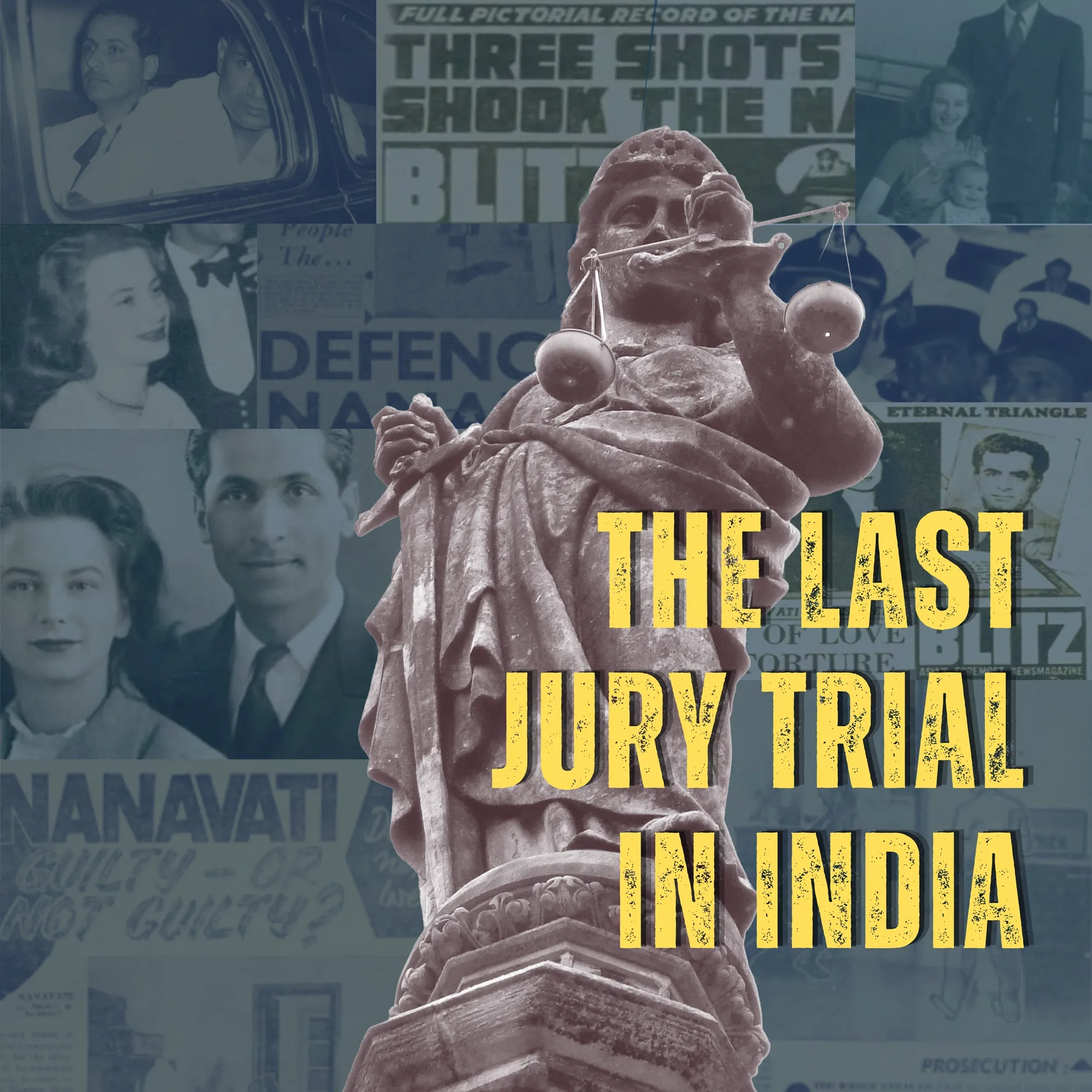
A podcast in four episodes
A sensational murder trial. A verdict that outraged a city. The end of the jury in India.
In 1959, a jury in Bombay acquitted Commander Kawas Nanavati of killing his wife’s lover. Many were outraged, and they blamed the jury. Political theorist Sonali Chakravarti follows trial by jury from colonial India to the drafting of the Constitution to India’s courts today, and asks what is lost when ordinary people no longer decide who is guilty.
Listen & subscribe
Coming soon. The links go live with the first episode.
- Apple PodcastsSoon
- SpotifySoon
- New Books NetworkSoon
- WESUSoon
- RSSSoon
Why this story
What is lost when ordinary people no longer decide?
In the United States, the right to a trial by jury is easy to take for granted. People grumble about jury duty. Yet the jury remains one of the most powerful ways ordinary people can resist a state that is punishing someone unfairly.
India once had jury trials too. The British introduced them to legitimize their rule as an empire of law. But the drafters of the 1950 Constitution, committed to universal suffrage, decided the jury was not worth fighting for, and in 1973 it was abolished.
The Last Jury Trial in India tells that story, and asks what another multicultural democracy can teach us about how democratic institutions survive, or decline.
The series
Four episodes
Episode 1 · Coming soon
The Pulse of the People
April, 1959, a respected naval commander comes back from time at sea to find out that his wife is having an affair. He drives to the apartment of his wife’s lover to talk to him. The lover ends up dead. The murder trial of Commander Kawas Nanavati captivated Bombay — it had sex, betrayal and intrigue. When the jury verdict came out, many were outraged and they thought the jury system was to blame. The trial came to be known as “The Last Jury Trial in India” because it heralded the end of the jury system in 1973. It was a lightning rod for concerns about the jury being corrupted by prejudice and the media.
Read more →Episode 2 · Coming soon
You Can’t Trust Them
If colonialism is a system of forced rule by an outside entity, why did the British introduce jury trials in India? Were they fair? This episode looks at two remarkable trials: the first is a murder trial over the killing of a British tea plantation owner by his workers, and the other is the 1908 trial of Bal Gangadhar Tilak. Tilak was the publisher of the most widely read newspaper in Western India and faced charges of sedition, that is, promoting “disaffection” for the king. Taken together, the trials show that the jury trial was meant to legitimize the British as an empire of law, but the way the trials were conducted revealed something more sinister.
Read more →Episode 3 · Coming soon
They, the People
Even though jury trials were suspended for many nationalist leaders, there were still moments when jurors exerted their power, as we see with the acquittal of Communist organizer, Philip Spratt, a focus of the episode. The threat of a jury undermining the prosecution in the sprawling Meerut Conspiracy Trial also led the colonial government to take drastic action. Lastly, this episode also looks at the drafting of the 1950 Indian Constitution and asks, “Why did a country that committed to universal suffrage decide that the jury trial was not worth fighting for?”
Read more →Episode 4 · Coming soon
The Case for Juries
How is the judge-centered legal system working in India today? The detention of Umar Khalid, an activist who protested the 2019 Citizenship Amendment Act, has gone on for more than 5 years, an experience consistent with the tremendous backlog of the system. What would happen if he had to have his case heard before a jury? This thought experiment of the jury trial in India is paired with a discussion of the legal system in Argentina where jury trials have recently been introduced in the most serious cases.
Read more →
Your host
Sonali Chakravarti
Sonali Chakravarti is Professor of Government at Wesleyan University and is the author of Radical Enfranchisement in the Jury Room and Public Life. She can be reached at schakravarti@wesleyan.edu.
- Host & writer
- Sonali Chakravarti
- Editorial team
- Sara McCrae
- Leah Feder
- Sound design & mix
- Emma Munger
- Cover art
- Supriya Kota